Presbyterian devotions and Presbyterian bloggers are hard to find. In this page you will discover Presbyterian devotions for church meetings and studies with elders, Sunday school classes and housegroups. Presbyterians are great thinkers, so be warned: these devotions are deep.
Tuesday, April 3, 2012
Presbyterian devotions: Holy Week - First to be Saved
Thursday, March 1, 2012
Easter devotion: Fact or Fantasy? - Matthew 27:64
Monday, May 16, 2011
Presbyterian Blogs: Face to Face - Hebrews 12 v 2
Wednesday, April 20, 2011
Presbyterian Devotions: A Tough Passage - Hebrews 6:4-6
Monday, April 18, 2011
Presbyterian Devotions - Holy Week - Just Like Us
Wednesday, April 13, 2011
Presbyterian Easter Devotions: My Last Easter - Hebrews 3:10-11
Tuesday, April 12, 2011
Presbyterian Devotions: God the Builder - Hebrews 3:4
Monday, March 29, 2010
Presbyterian Devotions: Holy Week Hell
Thursday, April 9, 2009
Presbyterian Devotions - Good Friday - Dying Faith
Luke 23:44-46 It was now about the sixth hour, and darkness came over the whole land until the ninth hour, for the sun stopped shining. And the curtain of the temple was torn in two. Jesus called out with a loud voice, "Father, into Your hands I commit my spirit." When he had said this, he breathed his last.
A lot of the divisions that we have in our churches today usually involve issues about how we live our lives as Christians. For some people, complete loyalty to the word of God is essential. For others, treating everyone as a child of God is of paramount importance. We battle each other constantly about how we interpret the scriptures by what we preach and practice. In other words, both groups use the Gospels as a means of showing us all how to live.
But in today’s scripture, we are not taught how to live. Instead, Jesus teaches us how to die. After enduring agony, suffering, and shame for hours, Jesus is ready to die. Mustering all of His remaining strength, He cries out loudly for everyone to hear: “Father, into Your hands I commit my spirit.” He completely surrenders Himself to God and unequivocally declares His faith in His Father. He does not mumble or mutter those words. He declares them openly, publicly, and loudly.
It is a complete validation of His life. He has lived it according to His Father’s will. Jesus now yields to death, but does not give Himself over to darkness or oblivion. He places His spirit into God’s hands. He confidently gives Himself over to God with His last dying breath.
One day, there will be an unavoidable moment in our own lives when we will take our last breath. It may be at home, in a hospital, or at a hospice. It could be unexpected, unintended, or accidental. Whatever the case or circumstances, Jesus has shown us how to die.
Prayer: Lord Jesus, we don’t like thinking about death or dying. We live our lives fully, doing our best to survive each day by trying to be healthy and happy. But one day, death will come. Help us to be spiritually prepared for that expected or unexpected moment. Come to us at that mysterious time and enable us to surrender our spirit into Your hands. In Your Holy Name, we humbly pray. Amen.
John Stuart is the pastor of Erin Presbyterian Church in
Wednesday, April 8, 2009
Presbyterian Devotions - Maundy Thursday - Traitors Anonymous
Every Maundy Thursday, I end up asking myself the same question: why did Jesus choose Judas to be one of his disciples? Couldn’t Christ, with all of His divine knowledge, have chosen a better person? After all, Judas was a weasel, who robbed from the ministry funds, disparaged other people, and whose name “Iscariot” – the dagger – aptly fits someone who will stab you in the back.
Jesus must have known what kind of unsavory character Judas was and yet He still picked him to be one of the Twelve. We know about how Jesus called the fishermen Peter and Andrew, James and John; we’ve heard about Matthew being called as he was gathering taxes for the Romans; we can read about Philip bringing Nathanael to Jesus in the Gospel of John; but what we don’t know is how Jesus called Judas personally, and what, where, when, and why were the circumstances.
It’s a puzzle and maybe because Judas turned out to be such a despicable traitor, his calling story wasn’t worth mentioning in the Gospels. But whatever happened, Jesus still called Judas to be one of the most important small religious groups ever to be established in the history of the world.
I don’t think that Jesus chose Judas because He needed someone to betray Him in order to be crucified. There had to be some sort of zeal, faith, and sincerity that Christ initially saw in Judas. He allowed him to be part of His ministry team for three years, so whatever Judas did before the last week of Christ’s life, it must have been valuable to Jesus.
In this country, when we think of traitors, the name “Benedict Arnold” usually springs to mind. We remember his deceit and disloyalty, his betrayal of Washington’s confidence and embarrassment to the cause for Independence. But we should also remember that before his treacherous act, Benedict Arnold was successful commander in Washington’s Army. He was a valued officer in the Continental Army.
So could Judas have been a worthy team member of Christ’s exclusive group? Was he a great teacher or preacher? Was Judas an organizer and administrator? Was he, in fact, dependable up until the last few weeks of Christ’s life? You would think that if Judas was such a low-down, lying and cheating, irredeemable rogue and scurrilous reprobate, Jesus would have thrown him off the team. After all, Christ wasn’t afraid to confront sinners with their sins, whether they were outsiders or a part of His entourage.
So what is happening here? Why does the Holy Son of God, anointed to become Savior of the world, healer of the nations, and King of all creation bother with such a louse as Judas? I think the answer can be summed up in one important word: grace. If Jesus could show such grace to an unworthy, unloving, disloyal traitor like Judas, then Christ can also show such grace to sinners like you and me.
Let’s be honest folks, the only reason that we feel sorry for Judas is because he represents every one of us. We all have betrayed Jesus in our lives. We all have done shameful things; we all are greedy and selfish, unfaithful and disloyal. In fact, if we were all to read these stories in the Gospel and replace the name “Judas” for our own, we know that we are quite capable of doing the same despicable things.
Hello. My name is John Stuart and I belong to a group called ‘Traitors Anonymous.’
Prayer: Lord Jesus, we all are guilty of betraying You at times. Sometimes we are embarrassed to say that we are Christians. Sometimes we fail to speak out when we see things that are immoral or wrong. Sometimes we neglect to pray, read our bible, or even worship You each day. Forgive our treacherous hearts and allow us the healing power of Your grace. In Your Holy Name, we humbly pray. Amen.
Friday, April 3, 2009
Presbyterian Devotions: Only One
I was partly listening to an interesting conversation on local radio this morning. It was all to do with a Methodist minister who has decided to become a Muslim. She doesn’t have any problem with this, and feels that the two faiths can be simultaneously followed by the one person. It just makes me wonder what she is looking for, and why she couldn’t find all that she spiritually needed in Christ alone.
People can sincerely believe anything that they want to in this life, but that doesn’t mean that they are right. I know many people who devote themselves to all kinds of different beliefs, but I honestly think that they are totally wrong. The Methodist minister who is now a Muslim is trying to make both those faiths fit together, but in reality they are poles apart. Jesus is The Christ, the One, Truly Anointed, Messenger, Prophet, and Son of God. There is no other Savior than Him. Christianity was founded on this absolute principle of faith; so to suggest that Jesus can share half of our devotion with someone or something else is just so wrong. The First Christians would never have diminished their beliefs in this fashion. I think that the Methodist Muslim minister is absolutely mistaken. She is idolizing her own self-made religion.
As we head into Holy Week, we all need to focus upon the passion and suffering of Jesus. He alone went to the Cross; He alone died for our sins; and He alone is truly resurrected from the grave. In other words, Christ did everything on His own. Our salvation comes from Him; our hopes lie with Him; and our immortality abides with Him. To quote from one of my favorite movies, ‘Highlander,’ – “There can be only One.”
Prayer: Lord Jesus, You came into world two thousand years ago to show the true way of finding God. Over the centuries, billions of people have accepted you as their Lord and Savior. Today, we count ourselves truly blessed to be amongst that amazing number. Help us to keep You in our hearts as we commemorate Holy Week and celebrate Easter. In Your Holy Name, we pray. Amen.
John Stuart is the pastor of Erin Presbyterian Church in Knoxville, Tennessee. If you would like to comment on today’s message, please send him an email to pastor@erinpresbyterian.org.
Thursday, March 12, 2009
Presbyterian Devotions: Blessed Boasting
Podcast version here: http://media.libsyn.com/media/stushie/Blessed_Boasting.mp3
Each year, I have the privilege of taking a part in a lunchtime ecumenical service at the local Roman Catholic church on Good Friday. Seven pastors, ministers, and priests give short 4-5 minute homilies on the Seven Last Words of Christ from the Cross. I’ve taken part in this service for about 11 years and it never ceases to amaze me how much the Holy Spirit inspires each speaker.
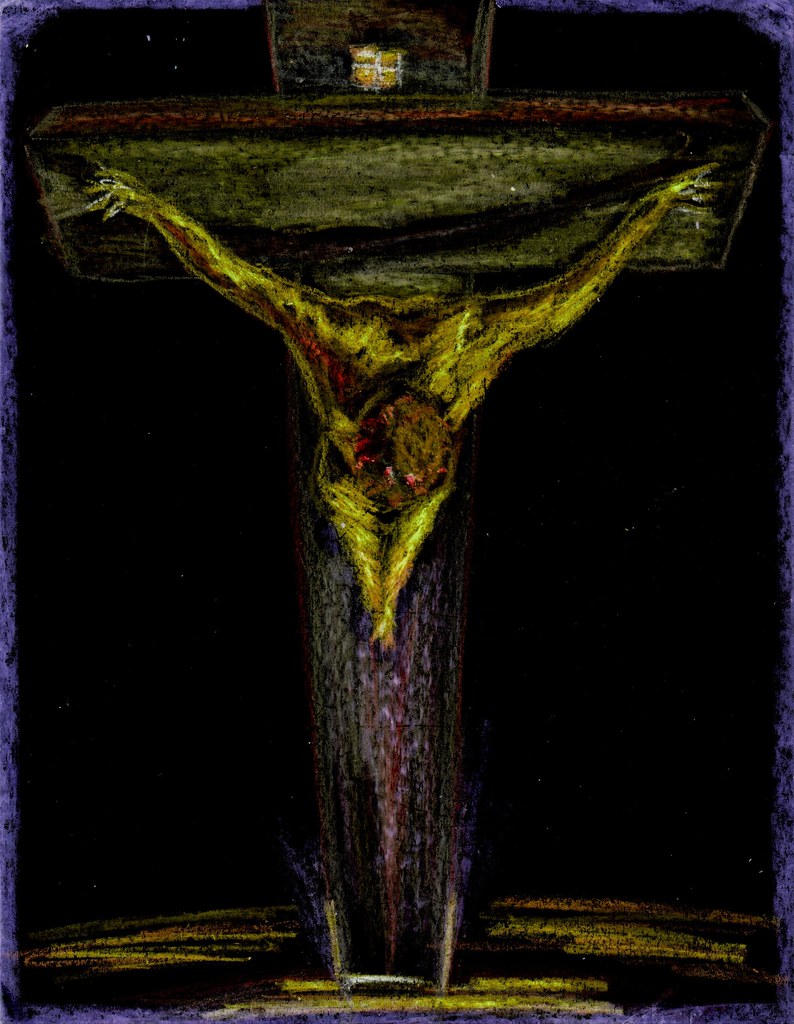
I love the fact that we all gather together in one sacred place, as one holy church. The Crucified figure of Christ looms above each speaker and adds a pictorial poignancy to what we express. The whole worship service is a solemn reminder of what Jesus endured to save us from our sins. It’s a miraculous moment of mystery when the speakers and worshippers alike sit in awe. The whole place and service makes me feel guilty and sorrowful, absolved and thankful all at the same time.
I love the Cross of Calvary, but I hate what happened to Jesus. I love the freedom He brings me, but I despise my sins which nailed Him to the Cross. Good Friday has a spiritual ambivalence and a bittersweet attachment to my soul. But it fully prepares me for the glorious goodness that I experience on Easter, when I am fully restored to God on Resurrection Sunday. The curse of the Cross is broken by the very first rays of the rising sun, given to us gladly by the grace of the Risen Son of God.
Prayer:
In the cross of Christ I glory,
Towering o’er the wrecks of time;
All the light of sacred story
Gathers round its head sublime.
When the woes of life o’ertake me,
Hopes deceive, and fears annoy,
Never shall the cross forsake me,
Lo! it glows with peace and joy. Amen. (John Bowring)
John Stuart is the pastor of Erin Presbyterian Church in Knoxville, Tennessee. If you would like to comment on today’s message, please send him an email to pastor@erinpresbyterian.org.
Thursday, March 5, 2009
Presbyterian Devotions: Garden of Grace
Podcast version here
Sometimes when I pray to Jesus, my heart is so full of the many ways in which I have disappointed Him. I’ll remember a harsh word that I’ve recently spoken, or a promise that I’ve cast aside, or even a person that I’ve unintentionally hurt.
I call myself a Christian, but I frequently fail to live up to the high expectations that both the Lord and the world have of His servants. And when my mistakes really burden me, I feel as though I’ve betrayed what Christ should mean to me and I’m sorry for being such a poor example to others.
When I read the story of Judas’ betrayal today, and I reflected upon it, I know that had I been there in the Garden of Gethsemane, I could have walked in Judas’ shoes. His greed and insecurity, his pride and bitterness, his act of betrayal and disloyalty could all have been mine. I feel as though I’ve failed my Lord and I don’t deserve His love.
And then a surprising thing happens: I re-read the scripture and I see an amazing moment of Christ’s grace. He doesn’t condemn Judas, or strike him down dead. Jesus doesn’t convict or judge His betrayer. Instead, He calls Judas “Friend.”
Through this revelation, the grace of God overflows and overwhelms my soul. I can ask for forgiveness and be restored because Christ still calls me, “Friend.” I don’t have to dwell on past disappointments or mistakes. I can come to the Lord humbly and sincerely. I can receive His pardon because He is still willing to accept me as His friend.
Whatever burdens we are carrying; whatever past failures there have been in our lives; whatever mistakes we have made or disappointments that we have created, know this: Jesus can forgive them all because no matter what we have thought, said, or done, He is still wiling to call us “Friend.”
Prayer: Lord Jesus, we all have been Judases in our lives and we are sorry for our sins. Come to us this day and cleanse us of the past. Restore us to Your present favor and lead us towards Your everlasting Kingdom. In Your Holy Name, we humbly pray. Amen.
John Stuart is the pastor of Erin Presbyterian Church in Knoxville, Tennessee. If you would like to comment on today’s message, please send him an email to pastor@erinpresbyterian.org.