Showing posts with label Lenten devotions. Show all posts

Wednesday, February 22, 2012

Presbyterian devotions: Lent Begins at 40 - Isaiah 51:11

Isaiah 51:11    The ransomed of the LORD will return. They will enter Zion with singing; everlasting joy will crown their heads. Gladness and joy will overtake them, and sorrow and sighing will flee away.

Today is Ash Wednesday, the first day of Lent. Millions of Christians around the world will attend worship services to have the sign of the Cross placed upon their forehead using the ashes of last year’s Palm branches. They do this as an act of penance, beginning a forty day journey of humility and contrition, in order to prepare their hearts and souls, bodies and minds for Holy Week and Easter.

It’s also a time when self-importance gives way to a focus upon God. Self-centered sin is cast side, to be replaced with a deeply spiritual awareness of who Jesus was, is, and ever shall be.

Lent begins at 40. The ashes represent sorrow and shame. The forty days are symbolic of Christ’s fasting in the wilderness just before He began His incredible three year journey of preaching, teaching, and healing. The whole season of Lent is meant to bring us closer to God by aligning our thoughts and acts, our words and ways with those of Jesus, our Lord and Savior. If we are successful in maintaining this focus, then Holy Week and Easter will become incredible too.

Prayer:                        Lord Jesus, as we begin this forty day journey of Lent, be with us step by step and day by day. Allow us the blessing of Your presence and guidance over everything that we think, do, or say. In Your Holy Name, we pray. Amen.

John Stuart is the pastor of Erin Presbyterian Church in Knoxville, Tennessee. If you would like to comment on today’s message, please send him an email to pastor@erinpresbyterian.org.

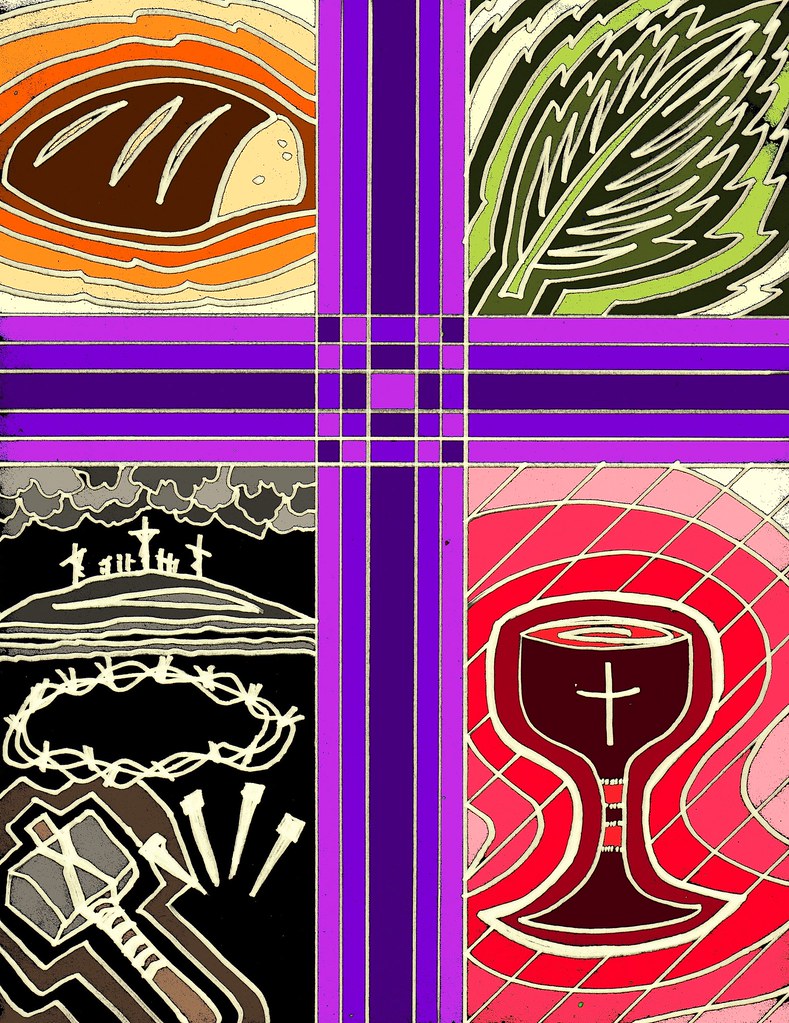
Today’s image is a bulletin cover designed by John for Lent and/or Holy Week. It is called “Purple Reign.” If you would like to view a larger version of the drawing, please click on the following link: http://farm8.staticflickr.com/7050/6913397537_14e0996d59_b.jpg

Monday, March 29, 2010

Presbyterian Devotions: Holy Week Hell

Mark 9:49       Everyone will be salted with fire.

I recently watched an animated version of the classical poem Dante’s Inferno. It depicted all of the excesses of medieval man’s imagery of hell. Souls were tormented and demons were diabolically cruel. The sign above the gates of hell told the whole story: “Abandon Hope All Ye Who Enter Here.”

These days, not many people believe in hell. They see it as an invention of religious fanatics who used it to control society, especially when the Church seemed to be all powerful during the Middle Ages. Post modern people reject such a notion, after all, why would a loving, creative, and gracious God permit such a hateful, destructive, and cruel place to exist?

The problem about hell for me is this: Christ believed it existed and He willingly died for us in order to save us from hell. If I deny hell’s existence, then I reject Christ’s beliefs. If I reject what Jesus said, then how can I be sure of my salvation? As usual, there’s no compromise. Either Christ told the truth or He lied.

Holy Week sees the end of Lent and the beginning of Christ’s passion (suffering) for the world. At the end of the week, He overcomes sin and death, and even hell. Hope is not abandoned, but it abounds. In Jesus, we can have the joy of salvation and the promise of heaven, but only if we accept Him as our One True and Only Savior.

Prayer:                        Lord Jesus, not one of us is comfortable with the existence of hell. We want to cast it aside and think about something pleasant. However, hell was real to You, so who are we to question Your words and ways, Your message and truth. Teach us this week that You can save us from hell and restore us to heaven. In Your Holy Name, we humbly pray. Amen.

John Stuart is the pastor of Erin Presbyterian Church in Knoxville, Tennessee. If you would like to comment on today’s message, please send him an email to pastor@erinpresbyterian.org.

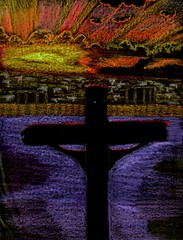
Today’s image is one of John’s 2010 Holy Week drawings. It’s called “Bloody Sunset” and depicts Christ on the Cross outside of the walls of Jerusalem. You can view a larger version of the drawing here: http://www.flickr.com/photos/traqair57/4471998398/sizes/l/

Friday, February 26, 2010

Presbyterian Devotions: Puzzling Preacher

Mark 6:20b         When Herod heard John, he was greatly puzzled; yet he liked to listen to him.

There’s a story told about a Protestant pastor who was arrested by the Gestapo in Nazi Germany. As well as being tortured and interrogated, he was also summoned into the presence of Hitler to talk about faith and theology. On each occasion, the pastor was so terrified that he could hardly say anything. Years later, when the war ended, he regretted the fact that he didn’t use his faith to make the evil dictator change his course. Hitler had appeared ready to listen, but the pastor couldn’t get over his fear.

It appears that Herod, the cruel king of Judah, was also willing to listen to a preacher. From the Gospels we learn that Herod liked to listen to John the Baptist, but was greatly puzzled by what he had to say. John must have challenged Herod’s thinking and stirred his conscience in ways that other men could not. Herod was so used to having his own way on his own terms that John’s words were so different. The preacher was telling the king to repent and this puzzled Herod because he ruled absolutely and had no trouble with his decisions. But there was something in John’s preaching that left him troubled and unsettled, possibly because Herod came up against direct honesty for the first time in his life.

I read a survey this morning from the Pew Research Council which seems to reveal that young people between the ages of 18-29 believe in God, but that they have no need for institutionalized religion or preachers. It makes me wonder what kind of faith that they really have (or don’t have). I know that Christ, the Holy Son of God, still went to worship in traditional institutionalized faith gatherings each week. I also know that it was His preaching that changed the world and that after Pentecost, all the remaining disciples became preachers. They shook up the world and, I firmly believe, they are still capable of doing that today.

Prayer:                 Lord Jesus, we thank You for the gift of preaching and for the preachers who have influenced our lives, affected our ways, and challenged our ideas. We pray that You will raise up a new generation of young preachers who can relate to their peers in honest, direct, and challenging ways. In Your Holy Name, we pray. Amen.

John Stuart is the pastor of Erin Presbyterian Church in Knoxville, Tennessee. If you would like to comment on today’s message, please send him an email to pastor@erinpresbyterian.org.

Today’s image is John’s drawing of a bluebird and is called “First of Spring.” It’s part of his bird series which you can view online at http://www.flickr.com/photos/traqair57/sets/72157623366524553/detail/

Thursday, February 25, 2010

Presbyterian Devotions: Jesus the Christ - Mark 6 v 13

Mark 6:13       They drove out many demons and anointed many sick people with oil and healed them.

The word ‘Christ’ means ‘the Anointed One’ and it was meant to signify that Jesus was specially chosen, divinely honored, and majestically exalted by God to be the Savior of His people. Anointing was primarily reserved for those who were to be crowned as ruler of a nation. Usually a priest did the anointing by pouring some precious oil on the forehead of the crown prince or high born ruler. If you look back at the old black and white recordings of the coronation of Queen Elizabeth II of Britain, you will see that the Archbishop of Canterbury anoints her during the ceremony. It is an ancient rite and one which marked rulers of kingdoms as being people who were specially chosen and predestined to reign by God.

In today’s Gospel passage, Christ uses anointing in a different way. Instead of reserving it for divinely chosen people and godly rulers, Jesus teaches the disciples to anoint those who are sick with oil before actually healing them. It’s as if Christ wanted to share His anointment with other people, especially those who were seriously sick and possibly at death’s door. Anointment then became an act of divine compassion instead of a holy rite of elitism. Jesus let His disciples show the weak and ill that they were not being punished by God, but instead that they were honored by God with His love, grace, and healing. Just as John was called the Baptist because he baptized people in the Jordan, so Jesus was called the Christ because He anointed people with God’s favor and healing.

Today we are all in need of God’s grace and Christ’s compassionate anointment. We have emotional, mental, and physical pains that bother, bruise, and burden us. Christ has the power to release us from past hurts and disappointments, present difficulties and circumstances, anxious moments and insecurity. If we allow Him into our lives, He can and will anoint us to heal us of the past, hold on to us presently, and lead us towards heaven and everlasting peace.

Prayer:                        Lord Jesus, You are the Christ, the Holy One chosen of God, who rules the universe, reconciles creation, and heals the entire world. You anointed the Earth with Your precious blood. You saved us from sin and compassionately healed the breach that separates us from God. Hallelujah! What a Savior! Amen.

John Stuart is the pastor of Erin Presbyterian Church in Knoxville, Tennessee. If you would like to comment on today’s message, please send him an email to pastor@erinpresbyterian.org.

Today’s image is from John’s Feast of Easter series and is called “Two More Days.” If you want to view the series, you can see them at the following link: http://www.flickr.com/photos/traqair57/sets/72157600054864349/detail/

Friday, February 19, 2010

Presbyterian Devotions: A Real Likeness - Psalm 17 v 15

Psalm 17:15 And I--in righteousness I will see your face; when I awake, I will be satisfied with seeing your likeness.

Yesterday I made a special presentation to our church Seniors group about my artwork. I showed them the processes that I use when I create a drawing of a place or animal. I think they were all fascinated by the procedure and I took great pleasure in seeing them pleased with my work.

My art is impressionistic which means that it is like the subjects that I draw, but not as real as a photograph. I love impressionism because it allows you to use different shades, colors and strokes to represent a building, a place, or a creature. Most people enjoy impressionism because it allows them to put the picture together in their minds rather than on the canvas. The viewer becomes a participant in the artistry and, because each person is different, everybody views the drawing in different ways.

When the writer of Psalm 17 declares that he will be satisfied with seeing the likeness of God, I think that he is talking about looking at God impressionistically. It’s as if the psalmist understands that he cannot gaze directly into the face of God, for that would put him on equal terms with God. Therefore he looks forward to the day when he will see the likeness, the impression, the representation of God. To me, this is a prophetic and messianic verse because the psalmist is referring to Christ.

I believe that when we look at God in eternity, we will see Jesus face-to-face. He allows us to view Him directly because He has made all things level through His sacrificial death and glorious resurrection. The Cross cancels out our sin, so that we are no longer separated from God. The Resurrection gives us an everlasting hope, so that we may enjoy and be in God’s presence forever.

Prayer:                        Lord Jesus, thank You for being the likeness of God for us. Thank You for making the way clear for us, so that we may look into Your eyes and know that You are our Lord and our God. Help us to share this good news with others today. In Your Holy Name, we pray. Amen.

John Stuart is the pastor of Erin Presbyterian Church in Knoxville, Tennessee. If you would like to comment on today’s message, please send him an email to pastor@erinpresbyterian.org.

John’s artwork is online at www.stushieart.wordpress.com. If you would like a signed copy of any piece, please contact him at the above email.

Today’s image is one that he completed last night. It is called “Iconic Moon” and features an American Bald eagle.