Showing posts with label devotions on prayer. Show all posts

Tuesday, January 3, 2012

Session devotions: Fifteen years of Grace - Isaiah 38:5

Today’s Bible readings: Isaiah 38:1-8 and Matthew 18:1-9

Isaiah 38:5      “Go and tell Hezekiah, ‘This is what the LORD, the God of your father David, says: I have heard your prayer and seen your tears; I will add fifteen years to your life.’” 

Last week, I wrote that Hezekiah was my favorite king in the Old Testament. This second incident from his life, which is recorded in the Bible, let’s you know why I like him. Hezekiah was given bad news from the prophet Isaiah about his impending death and so he did what his people had done for generations – he lay down and turned his head to the wall, surrendering himself to Death.

But Hezekiah was only human, so he also tearfully prayed to God for help, in the hope that things would be changed. It’s the same type of moving moment that Charles Dickens would use with his famous fictional character Ebenezer Scrooge. God sees Hezekiah’s humility and is moved by his tears. Events are changed and grace is given. In fact, Hezekiah is granted fifteen more additional years to his life and God confirms this with a miraculous sign involving the Sun and shadows.

One day in Heaven, I hope to walk with Hezekiah and ask him about that miraculous day. I want to hear how he felt and then give glory to God for such amazing grace. In my lifetime, I have seen similar events with people who are cancer survivors or heart surgery patients. They have a better understanding of what life is about and usually have a greater appreciation for the extension of their own lives. It’s a wonderful gift given by God through the skills and knowledge of surgeons, doctors, and nurses.

This week, we have each been given another year. We do not know what lies ahead of us but we all hope to experience God’s grace during it. If we place our lives into His hands at the beginning of this New Year, we will know one thing by the end of it: He is always in control.

Question for reflection:          What parts of my life do I truly have to give over to God and wait for His grace?

Prayer:                        Lord Jesus, at the beginning of this New Year, we have many hopes and dreams, issues and concerns. Grant us the courage and humility to hand them over to You. Help us to put You at the center of our lives, so that we may follow and serve You all the days of this year. In Your Holy Name, we pray. Amen.

John Stuart is the pastor of Erin Presbyterian Church in Knoxville, Tennessee. If you would like to comment on today’s message, please send him an email to pastor@erinpresbyterian.org.

Today’s image is John’s latest winter drawing. It’s called “Snowmobile” and features a classic car in the snow under a winter moon. If you would like to view a larger version of this drawing, please click on the following link: http://farm8.staticflickr.com/7149/6609941245_ec24cdb7a3_b.jpg

Tuesday, November 1, 2011

Presbyterian Devotions: Why Debts? - Matthew 6:12

Today’s Bible readings are Isaiah 16:1-5 and Matthew 6:5-15

Matthew 6:12                         Forgive us our debts, as we also have forgiven our debtors. 

Whenever I’m at a funeral or an ecumenical service where the Lord’s Prayer is spoken by all of the participants, there’s always an awkward moment when some people say debts and debtors or trespasses and trespassers, or sins and sinners. Whichever Christian tradition folks belong to will determine what they recite at that moment in the Lord’s Prayer.

But why do Presbyterians use the word ‘debts’ instead of ‘trespasses’ or ‘sins’? Is it an important distinction or can we all just get along and recite sins and sinners?

Most of what we believe as Presbyterians comes from Scotland. In Scotland, there is no law of trespass, unlike their English counterparts. This meant that when it came to saying the Lord’s Prayer, the words ‘trespass’ and ‘trespasses’ had no meaning for the Scots people. Scots, however, knew all about debts and debtors because it was mainly a merchant economy in the 16th century. Calvinists also believed in the substitutionary atonement of Christ, which emphasizes the fact that Jesus sacrificially substituted Himself on the Cross for us. This means that we are completely indebted to Him, so when we say ‘ forgive us our debts’ in the Lord’s Prayer, we are actually saying, “Forgive us of the sinful things in our lives that nailed Jesus to the Cross.” And when we add the phrase ‘as we forgive our debtors,’ we are actually asking God to forgive us in the same way that we deal with the personal injuries, wounds, and hurts which other people inflict upon us.

The older I get, the more important it becomes to me to maintain the traditions of the church in a very tradition-less world. But I’ve also come to realize that without the proper historical context, people cannot hold on to something which they do not understand. As a teaching elder, it’s my responsibility to get that information out to the people of God that I serve and love, so that they may confidently hold on to the essential tenets of our Reformed Faith. Substitutionary atonement is one of them.

Prayer:                       Lord Jesus, we are all indebted to You because You sacrificed Yourself as a ransom for our souls and as a substitute for our atonement. We did not deserve such a loving act of mercy and forgiveness, compassion and everlasting kindness. Forgive us our debts, as we forgive our debtors. In Your Holy Name, we humbly pray. Amen.

John Stuart is the pastor of Erin Presbyterian Church in Knoxville, Tennessee. If you would like to comment on today’s message or ask a question, please send him an email to pastor@erinpresbyterian.org.

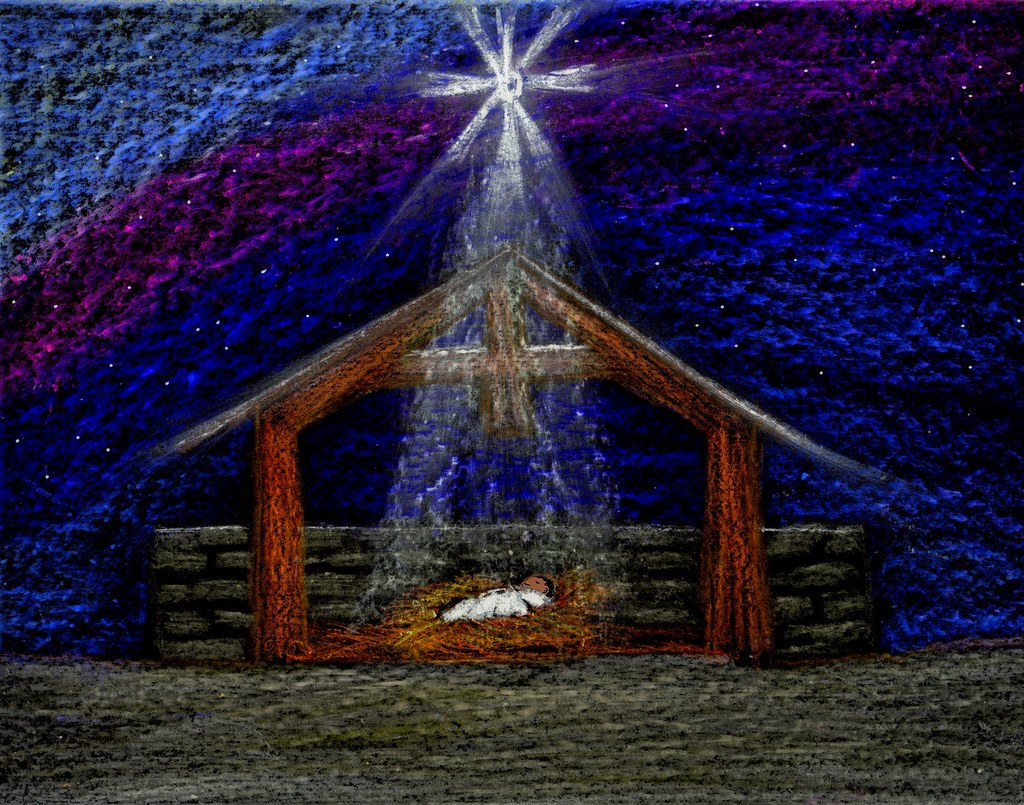
Today’s image is one of John’s 2011 Christmas drawings. It’s called ‘Heavenly Peace.’ If you would like to view a larger version of the drawing, please click on the following link: http://farm7.static.flickr.com/6057/6292689266_aab484f86b_b.jpg


Thursday, May 6, 2010

Presbyterian Devotions: National Day of Prayer - In Christ's Name

Mark 14:72     Immediately the rooster crowed the second time. Then Peter remembered the word Jesus had spoken to him: "Before the rooster crows twice you will disown me three times." And he broke down and wept.

Today, all around the nation, many prayer services will be held in churches and temples, government buildings and arenas. People of faith will gather together to specifically ask God to heal, bless, and prosper our country. In cities and towns across the States, people will listen to the prayers of church and political leaders, as well as praising God for all that He has done throughout our nations’ history.

Some of the prayer services will be controlled by the clergy, while others will be presented according to government guidelines. Jesus may or may not be mentioned, depending upon who structures the services and who is invited to lead them.

For me, this is a day when Christian pastors, who publicly pray, have a straightforward choice: to invoke the Name of Jesus and honorably make their prayers in His Sacred Name, or to give in to the secularists by setting aside Christ and making all prayers to God alone. In other words, pastors can choose to uplift the Name of Jesus and be associated with Him, or they can placate the crowd and deny Him, just like Peter.

I’ll be participating in a service at a Baptist church tonight, so I really cannot imagine that Christ’s Name won’t be invoked throughout the whole evening.

Praise the Lord!

Prayer:                        Lord Jesus, we want to honor You with our lips and our lives. Your Name is above all others in the Universe and Your Presence in more important than anything else on this day. Hear the prayers of Your followers for this nation today. May we be blessed by Your guidance, embraced by Your love, and enthused by the message of the Gospel and the ways of God’s Kingdom here on Earth. In Your Precious and Holy Name, we pray. Amen.

John Stuart is the pastor of Erin Presbyterian Church in Knoxville, Tennessee. If you would like to comment on today’s message, please send him an email to pastor@erinpresbyterian.org.

Wednesday, March 10, 2010

Presbyterian Devotions: Practicing His Preaching

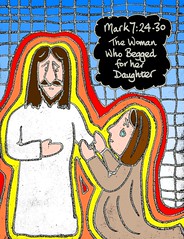
Mark 7:29        Then Jesus told her, "For such a reply, you may go; the demon has left your daughter."
           
This is an unusual story and an unlikely miracle from Jesus. It appears at first that Christ is reluctant to help the woman because she is a Gentile. She has to persist in order to get Jesus to do what she wants. This begs the question:  If she had been Jewish, would Jesus have treated her differently?

But I believe that there is a lot more to this event than just ‘He said, she said.’ Jesus’ credibility is on the line and His authenticity as a preacher is being challenged.

If you look back to the passage of scripture before this (Mark 7:17-23), you’ll see that Jesus had been preaching about what was clean and unclean. He was quite specific about what was holy and unholy, which meant that He was going against the traditional kosher values of His community. This was radical teaching as far as most of the Jewish clergy were concerned. It separated Jesus from His religious peers and must have upset more than a few people.

And yet in this incident, Christ seems to be following the traditional line that all foreigners were unclean and therefore unworthy of God’s blessings. The arch traditionalists would have been delighted at His initial response to the woman, but if Jesus had  left it there and didn’t heal the Syrophonecian woman’s daughter wouldn’t He have been guilty of hypocrisy, of not practicing what He Himself had only just preached?

As usual, there’s a lot more to this passage than we realize at first. I think Jesus highlights the lack of compassion that just keeping to the letter of the Law engenders. He has to go above and beyond the Law in order to help this woman and that, my friends, is what Christianity is all about.

I also think that Christ would have healed the young girl, but that the Syrophonecian woman showed that she was willing to beg for help, no matter what the cost was to her pride. This really impresses Jesus because it is an act of faithful submission and genuine prayer.  She doesn’t take Christ for granted and she fully relies upon Him to help in her time of greatest need.

We all come to Christ in prayer on a daily basis, but how many times do we take His blessings for granted? Perhaps the lesson that we all need to learn, especially during Lent, is to humbly approach the Lord with our personal requests.

Prayer:                        Lord Jesus, You ask us to seek You in prayer and to sincerely ask for guidance and help, forgiveness and healing. Sometimes we take You for granted because we are too busy to be humble and in too much of a hurry to wait. Forgive us for being self-focused. Help us to humbly pray. In Your Holy Name. Amen.

John Stuart is the pastor of Erin Presbyterian Church in Knoxville, Tennessee. If you would like to comment on today’s message or offer some feedback, please send him an email to pastor@erinpresbyterian.org.